A new report has raised serious questions about the fur industry’s lobbying in Brussels, after internal documents reportedly showed that Russian fur auction money was held in the same financial structure used to fund the industry’s EU political work.
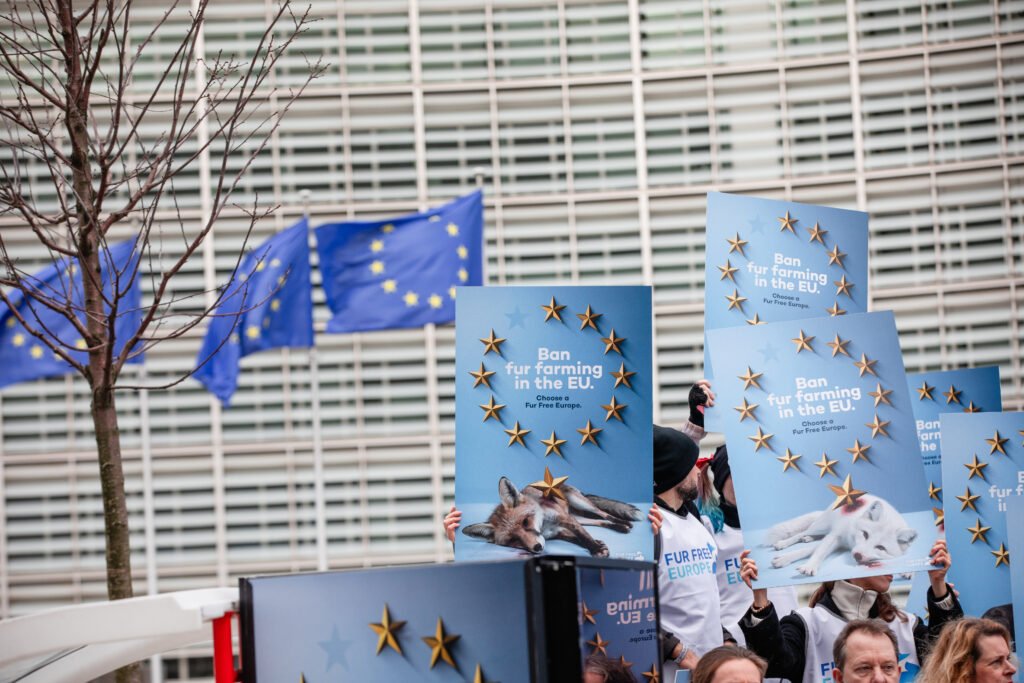
The revelations come at a critical moment for the Fur Free Europe European Citizens’ Initiative, which was backed by more than 1.5 million verified EU citizens calling for an end to fur farming and a ban on the placing of farmed fur products on the EU market.
According to POLITICO Europe, the International Fur Federation’s 2023 accounts recorded €223,870 from Sojuzpushnina, the St Petersburg fur auction house, while the same financial structure paid more than €216,000 to the industry’s Brussels lobbyist. The report also stated that the IFF’s 2024 budget included expected income from another Russian auction house.
This matters because the fur industry has also been lobbying the EU over new sanctions on Russian fur products and against the phase-out of fur farming proposed by Fur Free Europe.
The EU’s latest sanctions package extended restrictions on Russian fur by covering processed skins, including sable. The European Commission has valued EU imports of tanned fur skins from Russia at €12 million in 2024.
Respect for Animals believes these reports raise urgent questions about transparency, integrity and the public interest. The European Commission must ensure that no fur industry actor financially linked to Russian fur auction income is given privileged access or undue influence over either EU sanctions policy or the future of fur farming in Europe.
The timing is especially concerning. The Commission is expected to respond to the Fur Free Europe ECI, and a previously leaked draft Communication suggested that Commissioner Várhelyi may reject the ban requested by citizens and instead propose new welfare standards for fur farms, which is the very approach sought by the fur industry.
Such an approach would be unacceptable. The European Food Safety Authority has made clear that serious welfare problems on fur farms cannot be prevented or substantially mitigated within current cage-based systems. Fur Free Europe was not a call for different cage standards. It was a call to end fur farming.
The Commission’s handling of Fur Free Europe is already under scrutiny before the European Ombudsman. In a written answer to the European Parliament, Commissioner Várhelyi confirmed that workshops at the launch of the external study involved “only academia and fur farmers” and focused on developing “technical specifications” for the regulatory scenario preferred by the fur industry.
There was no equivalent technical process for the phase-out scenario demanded by more than 1.5 million EU citizens.
Respect for Animals is therefore calling on the European Commission to publish all relevant documents concerning fur industry engagement on both Russian sanctions and the Fur Free Europe process, and to guarantee that its final response is guided by science, democracy and the public interest, not by the commercial interests of the fur trade.
Richard Bissett, Campaigns Manager at Respect for Animals, said:
“These reports should alarm everyone who cares about transparency, animal welfare and the integrity of EU decision-making.
“At the very moment when the European Commission should be listening to citizens and following the scientific evidence, the fur industry appears to have been lobbying to weaken restrictions relating to Russian fur while also pushing against the phase-out demanded by Fur Free Europe.
“The Commission must now guarantee full transparency over all meetings, correspondence and briefings with fur industry representatives on both Russian sanctions and Fur Free Europe.
“EU citizens did not ask for the fur trade to be repackaged with low standards for fur farms. They asked for a Fur Free Europe. The only credible response is legislation to end fur farming and ban the placing of farmed fur products on the EU market.”
Respect for Animals has long campaigned to end the exploitation and killing of animals for fur. The organisation supports the Fur Free Europe call for an EU-wide ban on fur farming and on the placing of farmed fur products on the EU market.
At a time when the fur industry is facing serious questions over its financial links to Russian fur auctions, the Commission must not allow a shrinking and cruel industry to shape decisions that should be based on evidence, public opinion and the democratic mandate of European citizens.